Simulation for factories and supply chains, made usable
Run the factory before you build it.
MBW lets you test a change to your operation (a machine, a shift pattern, a layout, a supplier) and see what it really costs, before anyone signs anything.
Most factory decisions rest on spreadsheets and experience. MBW gives you the answer while the decision is still open.Most decisions that shape a factory are made on spreadsheets, vendor promises and experience. That works until the day it doesn't, and by then the money is spent. MBW gives you the answer while the decision is still open.
45 minutes, free. Bring one decision you are facing. No preparation needed.
Why we exist
Nobody should find out what a decision costs after the money is spent.
Our mission
“Welt und Wirtschaft in die Zukunft führen und vereinen.”
To lead the world and the economy into the future, and to unite them there.
Industry is being asked to change faster than at any point in living memory. Reduce the footprint. Shorten the lead time. Hold the margin. Do all three, and prove it.
Those demands usually become separate projects, quietly contradicting each other until capital is committed.Those demands are usually treated as separate projects, answered by separate teams, using separate assumptions. And they contradict each other quietly until someone has already committed the capital.
We think economy and world are one system, and a decision good for one and ruinous for the other was never measured properly.We think that is the wrong way round. The economy and the world it runs in are not two competing agendas to be traded off in a meeting. They are one system, and a decision that is good for one and ruinous for the other was simply never measured properly.
We believe the organisations still here in twenty years will be those that see the whole consequence first.We build MBW because we believe the organisations that will still be here in twenty years are the ones that can see the whole consequence of a change before they make it, not the ones that guessed well.
The problem
You are already making these decisions. You are just making them blind.
Nobody sets out to guess. Simulation used to cost more than the decision was worth and come too late.Nobody sets out to guess. The reason it happens is that simulation, the tool built to stop it, has historically cost more than the decision was worth and arrived after it had been taken.
Every option arrives with its own business case, built by whoever wants it. So the meeting argues about whose spreadsheet is right, and the option with the best advocate wins.
The same problem, at three levels
This is rarely felt as one problem. It is felt as three, by three different people who do not always realise they are describing the same thing.
“I can see the bottleneck will move if we add that machine. I cannot prove it, so we will find out in production.”
“I am asked to commit to a throughput figure I have no way to verify until the line is running.”
“We approved seven figures of capital on an estimate, and I still cannot tell the board what it bought us.”
If any of those sentences sounds like something said in your business this year, the rest of this page is about what to do instead.
What should be true
Before we show you the software, here is what we think a real answer looks like.
If you were designing the ideal way to make these decisions, with no regard for what happens to be on the market, you would probably ask for four things.
You can run it before you build it
Every option run as the real thing: your machines, shifts and people, hour by hour, not a spreadsheet average.
The answer arrives while the decision is open
Days from question to answer, and cheap enough to ask about ordinary decisions too.
Every number reconciles
Every hour, euro and kilogram is booked somewhere, and the totals agree, so a challenged figure holds.
One run answers both questions
Will it work? Should we do it? One run, one set of assumptions, read by the engineers and by the board.
The solution
One model of your operation, asked each of those five questions.
MBW models your line once and runs it as often as each question needs. Every answer comes with its uncertainty, every figure adds up.MBW models your line once: machines, people, shifts, breakdowns, movement, energy. It then runs that model as often as each question needs. Every answer comes with its uncertainty, every figure has to add up, and the same run speaks to the engineers and to the board.
MBW scores every option on one model, in six areas against today. What chance could explain is marked as noise.MBW runs every option on the same model and scores each on six areas against the line as it stands. What random variation could explain is marked as noise, each point of improvement carries its price, and moving the weighting shows where the lead would change hands.
An investment, as a use case
How we do it differently
Three choices that make this affordable, fast and defensible.
Simulation is not new. What has kept it out of reach is not the mathematics. It is how the tools around it were built. We made three decisions differently.
Built as one system from the first line of code
Designed backwards from your decision, MBW is one system, not five tools bolted together.MBW was designed backwards from the decision you need to make, not forwards from a simulation engine. Modelling, measurement, experiments, comparison and reporting are one system, not five tools bolted together.
That removes the integration and reconciliation work behind most of a classical study's cost, so impact arrives in the first weeks.That is what removes the integration work, the spreadsheets built by hand and the reconciliation meetings that make up most of the cost of a classical study. It is also why the impact arrives in the first weeks rather than after the platform project.
Usable by the people who own the problem
The person who understands the line should be able to model the line. MBW is built to be driven by process engineers, planners and managers, not only by simulation specialists.
The model is a readable file and a canvas, not a black box. Mistype, and it says what it expected.The model is a readable file and a visual canvas, not a black box. When you mistype something it tells you exactly what it expected instead of quietly running something you did not mean.
Honest about what it does not know
Every comparison has a confidence interval, and what noise could explain is labelled so, in plain words.Every comparison carries a confidence interval, and any difference that cannot be separated from random variation is labelled as such, in plain words rather than as statistical shorthand in a footnote.
A tool reporting a 2% gain it cannot tell from noise is worse than none. MBW would rather say it does not know.A tool that reports a 2% improvement it cannot actually distinguish from noise is worse than no tool at all, because it is confidently wrong and you will act on it. MBW would rather tell you it does not know.
What you get
A working model of your operation, and answers you can defend.
Everything below is in the software today. Each one is there because leaving it out is how simulation projects usually fail.
Build the model without writing code
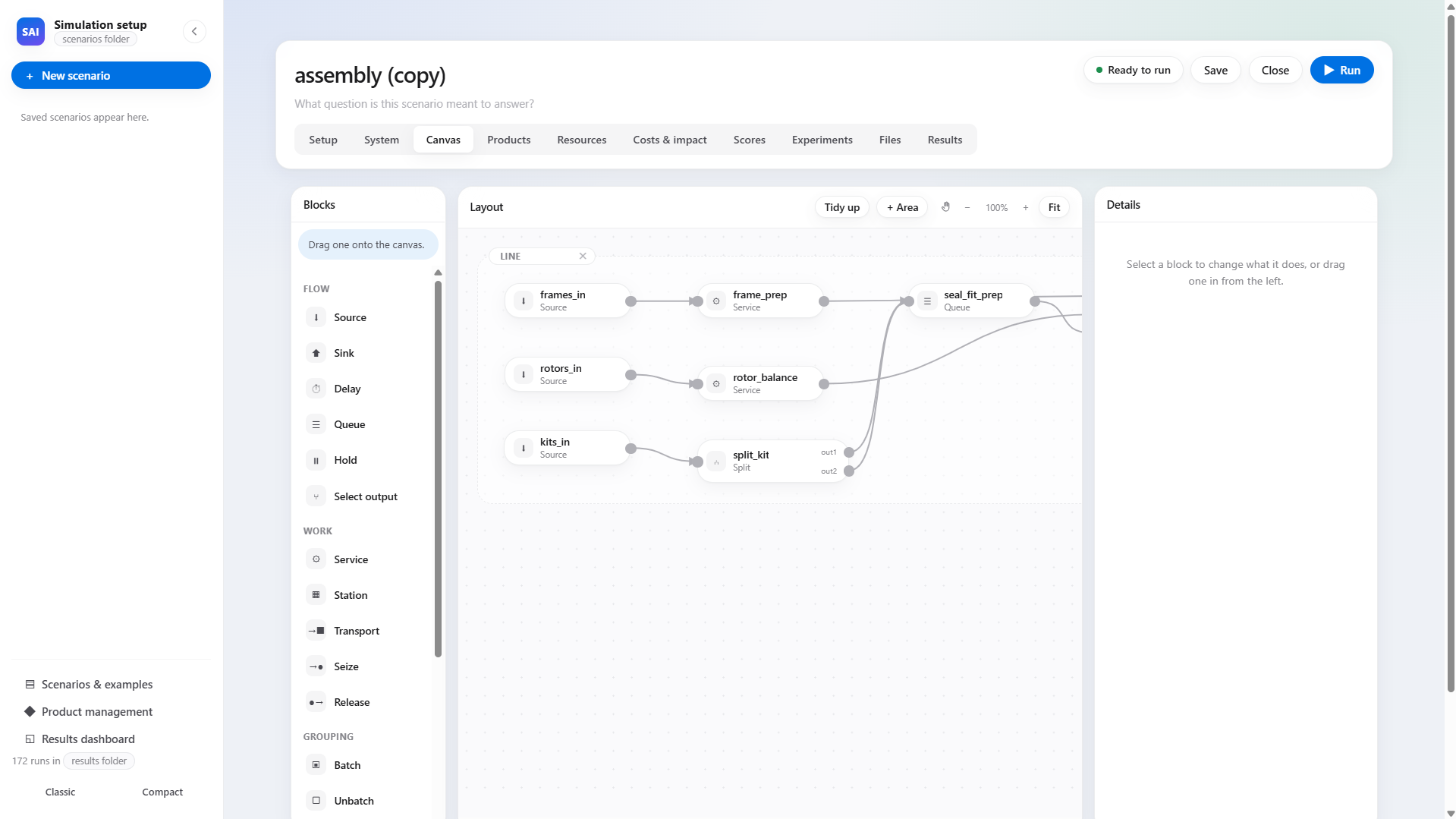
Machines, buffers, assembly, vehicles, conveyors and storage, placed as building blocks on a canvas or written as a readable file your team can review.
Building blocks · canvas · readable file
Measure everything, on one ledger that closes
Measures for the whole system, every block, resource, product and unit. Every machine hour is booked, so the totals add up exactly.
Measures at every level · closed ledger
Compare options with statistical honesty
Every scenario runs many times under different random conditions, and differences too small to tell from noise are flagged, not reported as findings.
Replications · confidence intervals
Let it search for the answer
Set the goal and the constraints, and MBW searches across operators, buffer sizes and shift patterns, then reports what it tried, what won and which levers mattered.
Optimisation · sweeps · sensitivity
One run, every perspective
Results roll up into scores from economics to sustainability, weighted by what your business cares about. Cost and footprint come from one set of assumptions.
Weighted sections · one run
On your own data, every morning
Once the model holds, it reads orders, shifts, people, machines and stock from your systems and, before the early shift, finds the cheapest plan that still delivers.
Live data · forecast · plan of the day
Inside the software
The parts you will work with, one at a time.
Lay out the line on a canvas, then shifts, resources, costs and goals, each in its own tab. Everything is checked as you type, before anything runs.
The whole cycle
This is not a project with an end date.
A study answers one question and is filed. A model you trust keeps earning: it finds the bottleneck, tests an investment, then plans each day.A simulation study answers one question and is filed. A model of your operation is different: once it exists and is trusted, it keeps earning. The same model that told you where the bottleneck is becomes the one you test an investment against, then the one you optimise, then the one that plans each day before the early shift starts. And what you learn there feeds straight back into the next strategic conversation.
01 · Current status
See and understand how things are currently done.
The operation as it really runs, not as documented. The first model usually ends a long argument by making it measurable.Before anything is changed: the operation as it actually runs, not as the process documentation claims. The first model usually settles an argument that has been running for years, because it makes the disagreement measurable.
- The line as it is today, hour by hour rather than on average
- Where work really waits, and on what
- A shared picture that both the floor and the board can look at
And back to the beginning: what operations learns becomes the new current status.
For your team
The same run, read two ways.
Engineers and decision makers read the same run, on one set of assumptions. So the talk is about the decision, not whose numbers are right.A simulation that only engineers can read does not change decisions. One that only shows headlines does not survive scrutiny. MBW reports both, from one run and one set of assumptions. So the conversation between the two is about the decision, not about whose numbers are right.
For engineers and process experts
“Where does it actually break, and why?”
Simulation engineers · process engineers · logistics and supply chain planners
Full depth: follow one part through each station, see what it waited on and how long, and where a change leads.Full depth, with nothing hidden behind a summary. Follow a single part through every station it visited, see which resource it waited on and for how long, and trace a change through to the consequence three steps downstream.
- Ledgers per unit: every visit, wait, seizure and blockage for any individual item
- Utilisation measured against rostered hours rather than the clock, with overtime reported separately
- Bottleneck and dependency analysis: what moves when you change one thing
- Distance, travel time and handling per product and per vehicle, loaded and empty
- Reconciliation identities that make a modelling error visible instead of plausible
- Every live run names the data it read, kept as a snapshot so it can be run again
For decision makers
“What does this mean for us, and where should we put our money?”
Managing directors · plant and operations managers · finance · sustainability leads
The same run, answered as a decision rather than a dataset. Which option wins, by how much, how confident we are, and what it costs to get there.
- A ranked verdict across the six sections, weighted by your priorities
- What each option costs per unit of improvement it actually delivers
- Where the ranking changes if your priorities change, before someone argues about it in the room
- Which differences are real and which are noise, stated in plain language
- A product passport: what a finished unit cost, consumed and emitted
- Proposed actions, each with the facts and thresholds that led to it
Sustainability
Cost and footprint, answered in the same run.
Model efficiency and decarbonisation apart, and the clash shows after the capital is committed. It is the same factory, measured twice.Most organisations model efficiency and decarbonisation separately, with different teams and different assumptions, and discover the contradiction after the capital is committed. They are not separate questions. They are the same factory, measured twice.
Measured per unit, not per site per year
Energy, emissions, water and material are tracked per unit, showing which product line to change. A yearly site total cannot.Energy, emissions, water and material flow are tracked at the same level as cost and throughput, down to the individual unit produced. An annual site total tells you nothing about which product line to change; a figure per unit tells you exactly.
Scope 1, 2 and 3 in one accounting
Grid CO₂ hour by hour, your own solar and wind, and the carbon in what you buy. Moving emissions to a supplier shows as just that, not as a saving.Electricity drawn on site with the grid's CO₂ hour by hour, what your own solar and wind made, and the embodied carbon of what you buy in, including inbound transport distance. A change that moves emissions from your balance sheet to a supplier's is visible as exactly that, rather than as a saving.
A product passport that separates fact from claim
Each figure names its source: measured, declared by you or derived from components. Nothing is overstated by accident.Recycled content, recyclability, regulated substances, expected lifespan. Every figure is labelled by where it came from: measured in the run, declared by you, or derived from components. So nothing is ever overstated by accident.
Decarbonisation with its operating cost attached
An emissions cut that adds lead time is no win; nor is efficiency that raises the footprint. One run scores both, in time to choose.A measure that cuts emissions and quietly adds two hours to lead time is not a win, and neither is an efficiency gain that raises the footprint. Because both are scored in the same run, you see both sides while you can still choose differently.
Economy and world are one system: a gain for one that harms the other was never measured properly.This is the practical form of our mission. An economy and the world it runs in are one system, and a decision that helps one while damaging the other was simply never measured properly.
Explore sustainabilityWhere we are
MBW is new. Here is exactly what that means.
We have no customer logos yet. We show what the software does today, and you can check every claim here against it.We are not going to show you a wall of customer logos, because we do not have one yet. What we can show you is what the software actually does today, and you are welcome to check every claim on this page against it.
22
worked examples
Runnable models, each teaching one idea, from a first line to this week's plan
747
requirements tested in full
Of 774 written down, each tied to the tests that hold it; the rest are tested in part or still open, and listed as such
What we are not claiming
No case studies or named customers yet, and no ROI from another factory. Need a reference first? Then we are not the right partner today.No case studies, no named customers, no ROI figure taken from someone else's factory. Those come from real deployments, and ours are ahead of us rather than behind us. If you need a reference customer before you can move, we are not the right partner today, and we would rather say so now than waste your quarter.
Reserved: customer proof
Leave this empty until there is something true to put in it. When the first pilots complete, this becomes a row of three short quotes with name, role and company, or a logo strip. Do not fill it with stock photography of people in hard hats pointing at tablets. An obviously empty space is more credible than obviously fake proof.
The business case
The question is not what simulation costs. It is what being wrong costs.
We won't show you an average saving from someone else's factory. The only business case that counts is built from your own numbers. So here is how to build it in a minute.
What being wrong costs you
A wrong call is an investment that did not pay, a volume promised and not delivered, a line staffed for a week that never came. These are the problems this page began with.
The money that did not pay back, or the margin on what you could not deliver.
Only those decided without a model today.
Your own estimate. Nobody knows your record better.
Put in your three numbers, and what being wrong costs you appears here.
Cost of one wrong call × decisions a year ÷ N, where one in N goes wrong.
Worked out in your browser. Nothing you type is sent or stored.
Why an answer costs less with MBW
Time to an answer
A classical studyMonths
With MBWDays
Who does the work
A classical studyA specialist, when available
With MBWThe people who own the process
What remains afterwards
A classical studyA report; the model is rarely kept up
With MBWA model your team keeps using
Cost and footprint
A classical studyTwo projects
With MBWOne run
How you pay
Single purchase
Maintenance included, without new updates.
Subscription (SaaS)
Maintenance and updates included.
Where MBW runs is your choice too: on your own computers or on our servers.
If a model changes even one of those decisions, that decision is the business case.
Start with one decision you are facing now. On the call we work its business case through with your numbers, including where MBW would not have helped.
Straight answers
The questions people actually ask us.
Do we need a simulation expert on staff?
No. MBW is built so that the person who understands the process can build the model. That is the point of it. An expert makes you faster and will get more out of the deeper analysis, but the tool does not assume one, and it explains its own mistakes rather than failing silently.
How accurate is it really?
A simulation is exactly as good as what you tell it. MBW's contribution is that it never quietly invents a number: anything it has not been told is reported as unknown rather than as zero, its internal accounting has to balance, and every comparison carries a confidence interval. Where it does not know, it says so.
What data do we need before we can start?
Less than you think for a first useful answer: cycle times, shift patterns, the route work takes, and roughly what things cost. Most operations already have this. We start with what you have, and the model tells us where more precision would actually change the answer, so you only go looking for the data that matters.
Can it read from our own systems?
Yes, from a SQL database (SQLite or PostgreSQL). Orders, products and bills of materials, rates, shift patterns, people and their absences, holidays, machines, breakdown history and stock can each be read as of a moment, and what was read is kept with the run so it can be repeated. Your files stay the truth: nothing is written into them unless you ask, and a source that cannot be read stops the run, unless you have said it may fall back to the model's own values. The tables it keeps for itself are its own, and the SQL that creates them is printed for your IT to read before anything is made.
Where does it run, and how do we buy it?
Both are your choice. It runs on your own computers or on our servers, and you can buy it once (maintenance included, without new updates) or take it as a subscription (SaaS) with maintenance and updates included. On a server, each person logs in with a role, which settles who may build and run models, who may only read results and who receives which report. What anyone changes carries their name.
Is it available in German?
Throughout. The screens, the dashboard, the reports and the morning mails all exist in German and English, numbers and dates are written the way each language writes them, and every reader receives their report in their own language.
Does an AI decide for us?
No. Results come from the simulation, and the proposed actions come from an explicit rule book of about fifty rules you can read. Each proposal shows the facts that triggered it and the threshold each one met. Where the evidence does not separate an option from random variation, the proposal says it is only indicative.
How long before we see something useful?
A first working model of a production line is usually days, not months. That is the whole design goal: fast enough to be worth asking about an ordinary decision.
Does it handle sustainability, or only cost?
Both, from the same run. Energy, emissions, water and material flow are measured alongside cost, throughput and delivery, so a change that improves one and damages another is visible immediately rather than in a separate report six months later.
Can it run our whole supply chain, not just one plant?
Yes. The same building blocks describe a workstation, a plant, or a network with transport between sites, inbound logistics and the emissions that come with them.
The next step
Bring us one decision you are facing.
No sales pitch: 45 minutes on one real question in your operation. We tell you what MBW would show you, and when it would not help.Not a sales pitch and not a procurement process: 45 minutes on one real question in your operation. The machine you are unsure about, the shift pattern nobody agrees on, the line that will not hit its number. We tell you what MBW would show you, and when it would not help.
- 1
Pick a time
Online, whenever suits you: by video call or by phone, in German or English.
- 2
Tell us the decision in two lines
So we come prepared. You don't have to: if you have rough numbers for the business case, bring them.
- 3
Talk for 45 minutes
With someone from the business side and someone from engineering, at the same call. You leave knowing whether a model would change that decision.
Free and without obligation. When we confirm the meeting, we tell you who will join.
Prefer to write? hello@modelingabetterworld.com